


Start Slideshow


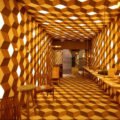 Bamboo LED by Jeff Dah-Yue ShiTaiwanese designer <a title="Jeff dah-yue shi" href="http://www.shidahyue.com/enter.html">Jeff Dah-Yue Shi</a> has struck an unconventional balance between green building materials and energy-efficient illumination with his beautiful <a title="Bamboo LED" href="http://www.shidahyue.com/enter.html">Bamboo LED</a> system. The tessellated bamboo panels and LED lights fit together to create walls, ceilings and floors. The fresh approach to interior lighting bagged the <a title="Taiwan Design Center" href="http://www.tdc.org.tw/en_about02.htm">Taiwan Design Center</a>'s gold pin design award in 2011.1
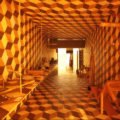 Bamboo LED by Jeff Dah-Yue ShiDah-Yue Shi's <a href="http://www.shidahyue.com/enter.html">Bamboo LED</a> system can be used to illuminate minimalist spaces without the use of protruding lighting fixtures.2
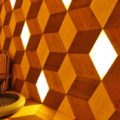 Bamboo LED by Jeff Dah-Yue ShiThe luminous panels are composed of three main parts: (1) an <a href="http://inhabitat.com/tag/led/">LED light source</a> at the base, (2) tempered glass on top of the base to consolidate the entire structure, (3) A thin <a href="http://inhabitat.com/tag/bamboo/">bamboo</a> veneer to filter the light.3
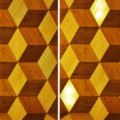 Bamboo LED by Jeff Dah-Yue ShiDue to the pattern of the bamboo veneers and the different levels of color intensity, the system creates the illusion of being three-dimensional.4
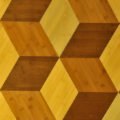 Bamboo LED by Jeff Dah-Yue ShiSeveral patterns can be created, rendering the design dynamic and modular. In addition to using green materials such as bamboo and LED lights, the recessed fixtures simplify manufacturing costs and minimize material use.5
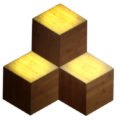 Bamboo LED by Jeff Dah-Yue ShiApart from the Op Art look and feel (which may well popularize the Bamboo LED in high-end offices, residences, clubs etc.), we love the design's dual function as a recessed luminaire and a structural <a href="http://inhabitat.com/materials/">material</a>.6
