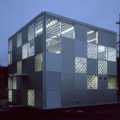
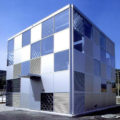
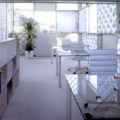
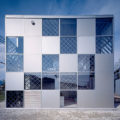
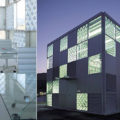
Riken Yamamoto‘s Ecoms House exemplifies a new kind of home economics. Constructed out of aluminum panels, this diminutive 24-foot by 24-foot box demonstrates how economy in size and fabrication can lead to surplus in style and coolness. A prototype residence for SUS Corporation, a manufacturer of aluminum precision machine parts and furniture, this home was initially an experiment to create something out of aluminum that could not be expressed with steel. The exterior is inspired by the traditional use of tatami mats in Japanese homes — each of the four sides featuring transparent, opaque, and glass-covered aluminum lattice panels.
Related Posts
-
After receiving tons of great submissions for our Green Home Showcase call for entries, we’re happy to bring you the first of our top 5
-
The Dune House is located in Thorpeness, England overlooking the sea off the Suffolk coast. JVA worked closely with Mole Architects to design this vacation
-
Photo via Engadget We love gadgets that serve dual purposes, so when we came across these solar windows from Hua Qin we were giddy with excitement.
6 Responses to “PREFAB FRIDAY: Riken Yamamoto’s Ecoms House”
-
Featured Author
Inhabitat Green Holiday Gift Guide: Handcrafted Gifts
Green Laundry 101: How to Get Rid of Stains
Osborn Architects Re-Imagines Paved Parking Lots as an Urban Forest
Green Laundry 101: Tips to Save Some Green in the Laundry Room
This author's twitter feed is currently unavailable. Please try again later.
-
Read Inhabitat
-
Search Categories
-
Recent Posts
-
Recent Comments
-
Browse by Keyword
follow inhabitat on:
popular today
all time
most commented
more popular stories >
© Inhabitat.com 2012 | About Inhabitat | Contact Us | Advertising with Inhabitat | Terms Of Use | Privacy Policy | Inhabitat, LLC


Maybe cool, maybe just ugly, but every interior feature in the photos is a cleaning nightmare, particularly the diamond window lattices. If only architects and designers had to clean houses before they were allowed to design them . . . .
I don’t se any sign of interior stairs or an elevator. With so many who need housing getting older and accessibility requirements for public, commercial buildings., it seems odd to create designs which require mountain-climbing skills to get to the second floor.
That, Sarah, is a great observation. The focus here was definitely on the practicality of production, not the practicality of everyday living.
LOL Sarah – that was my first thought too. Must be a girl thing to notice that right away. Other than that – interesting concept – maybe a little softening needed with some more organic elements continuing with the Japanese-inspired theme. Throw in a bit of wabi-sabi
. Also, I second the accessibility issue – especially in North America where the Boomers are the dominant force still… that will be the business to be in; accessible spaces that are modular for future use.
super cool … a little stark, almost takes me back to ’20s design somehow.
would melt.